Mahjong Tile Two Of Characters
U+1F008Mahjong Tiles
Copy and paste 🀈. The Mahjong Tile Two Of Characters character has Unicode code point U+1F008 and decimal HTML code 🀈.
Symbol codes
- Unicode
U+1F008- HTML Code
🀈- CSS Code
\1F008- HEX Code
🀈
Technical properties
Unicode 18.0.0
- Code point
- U+1F008
- Decimal
- 126984
- Unicode name
- MAHJONG TILE TWO OF CHARACTERS
- Block
- Mahjong Tiles · U+1F000–U+1F02F
- General category
- Other Symbol (So)
- Script
- Common
- Introduced
- Unicode 5.1
- JavaScript
- "\u{1F008}"
Appears in
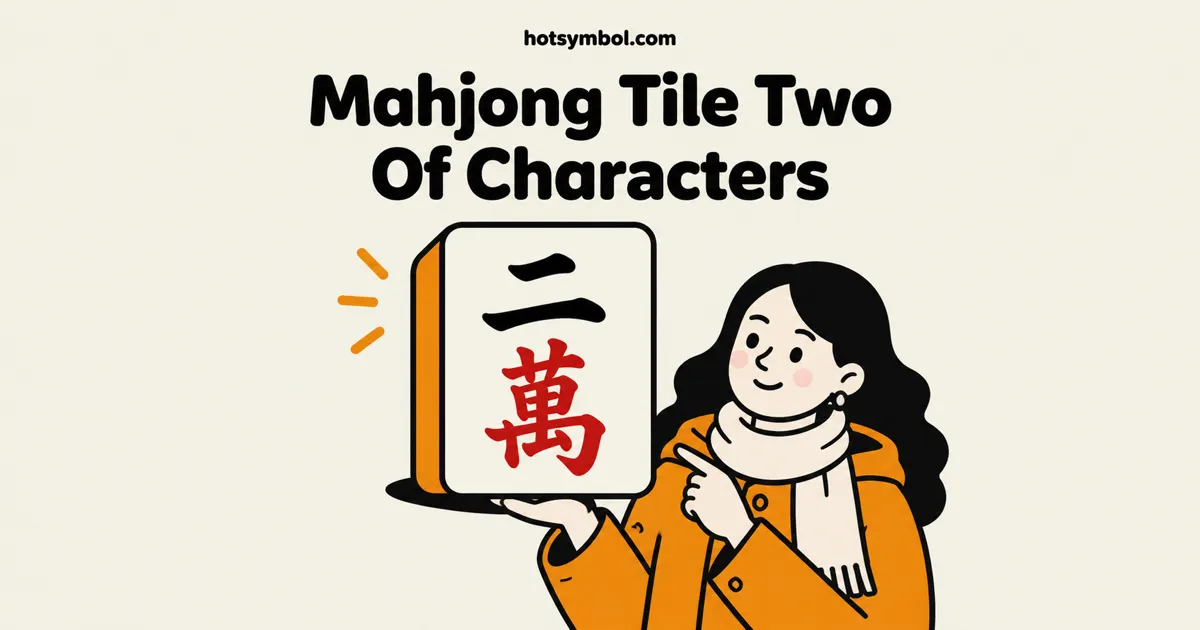
About Mahjong Tile Two Of Characters
🀈 is encoded in Unicode as code point U+1F008 (decimal 126984). Its official Unicode name is MAHJONG TILE TWO OF CHARACTERS.
It belongs to the Mahjong Tiles block (U+1F000–U+1F02F), its General Category is Other Symbol (So), and it was added in Unicode 5.1, released in 2008. Its script value is Common: it is shared across writing systems rather than belonging to one.
Sources: Unicode Character Database 18.0.0.
How to type or insert Mahjong Tile Two Of Characters
- Any device
- Select Copy symbol, then paste with Ctrl+V, or ⌘+V on a Mac.
- Microsoft Word
- Type
1F008, then press Alt+X. - macOS Character Viewer
- Press Control+⌘+Space and search for “mahjong tile two of characters”.
- Linux (GTK and IBus)
- Press Ctrl+Shift+U, type
1f008, then press Space. - HTML
🀈. In a UTF-8 page you can also paste the character itself.- CSS
content: "\1F008";in a::beforeor::afterrule.- JavaScript
"\u{1F008}"
Common questions about Mahjong Tile Two Of Characters
What is the Mahjong Tile Two Of Characters symbol?
🀈 (Mahjong Tile Two Of Characters) is a symbol in Unicode’s Mahjong Tiles block. Its code point is U+1F008, and it has been part of the standard since Unicode 5.1 (2008).
How do I copy and paste the Mahjong Tile Two Of Characters symbol?
Select Copy symbol at the top of this page, then paste with Ctrl+V on Windows and Linux or ⌘+V on a Mac. On a phone, tap Copy symbol, then touch and hold where you want it and choose Paste. 🀈 pastes as ordinary text, so it works in documents, messages, and code.
How do I type the Mahjong Tile Two Of Characters symbol on Windows?
In Microsoft Word, type 1F008 and press Alt+X to turn the code into 🀈. In other apps, the quickest way is to copy it from this page.
How do I type the Mahjong Tile Two Of Characters symbol on a Mac?
Press Control+⌘+Space to open the Character Viewer, search for “mahjong tile two of characters”, and double-click the result to insert it.
How do I type the Mahjong Tile Two Of Characters symbol on an iPhone or Android phone?
The simplest way is to copy it from this page and paste it where you need it. If you use it often, save it as a text shortcut: on iPhone, go to Settings > General > Keyboard > Text Replacement; with Gboard on Android, go to Gboard settings > Dictionary > Personal dictionary.
Can I use the Mahjong Tile Two Of Characters symbol in Word, Google Docs, and social media?
Yes. 🀈 is a standard Unicode character, so you can paste it into Microsoft Word, Google Docs, emails, and posts or bios on Instagram, X, Facebook, and TikTok. In Google Docs you can also choose Insert > Special characters and search for “mahjong tile two of characters”. In Word, choose Insert > Symbol > More Symbols, set from to Unicode (hex), and enter 1F008 as the character code.
Is the Mahjong Tile Two Of Characters symbol an emoji?
No. 🀈 is a text symbol, not an emoji. It takes the color and size of the surrounding text, and its exact shape depends on the font.
Why does the Mahjong Tile Two Of Characters symbol show as a box or question mark?
An empty box or a question mark means the font on that device has no glyph for 🀈. The character is still there: it appears correctly wherever a font covers Unicode’s Mahjong Tiles block, and free font families such as Google Noto cover nearly all of Unicode.
What are the HTML and CSS codes for the Mahjong Tile Two Of Characters symbol?
In HTML, write 🀈 (decimal) or 🀈 (hexadecimal). In CSS, use content: "\1F008"; in a ::before or ::after rule, and in JavaScript "\u{1F008}". See all HTML codes.